


Providing access to the machines you need
Levels Above can cater to your machine requirements with ease, simply contact our Hire Desk to let us know what you need today:

Hire Desk
Unit D, Fox Way, Trinity Business Park, Wakefield, WF2 8EE
Levels Above can cater to your machine requirements with ease, simply contact our Hire Desk to let us know what you need today:
Unit D, Fox Way, Trinity Business Park, Wakefield, WF2 8EE
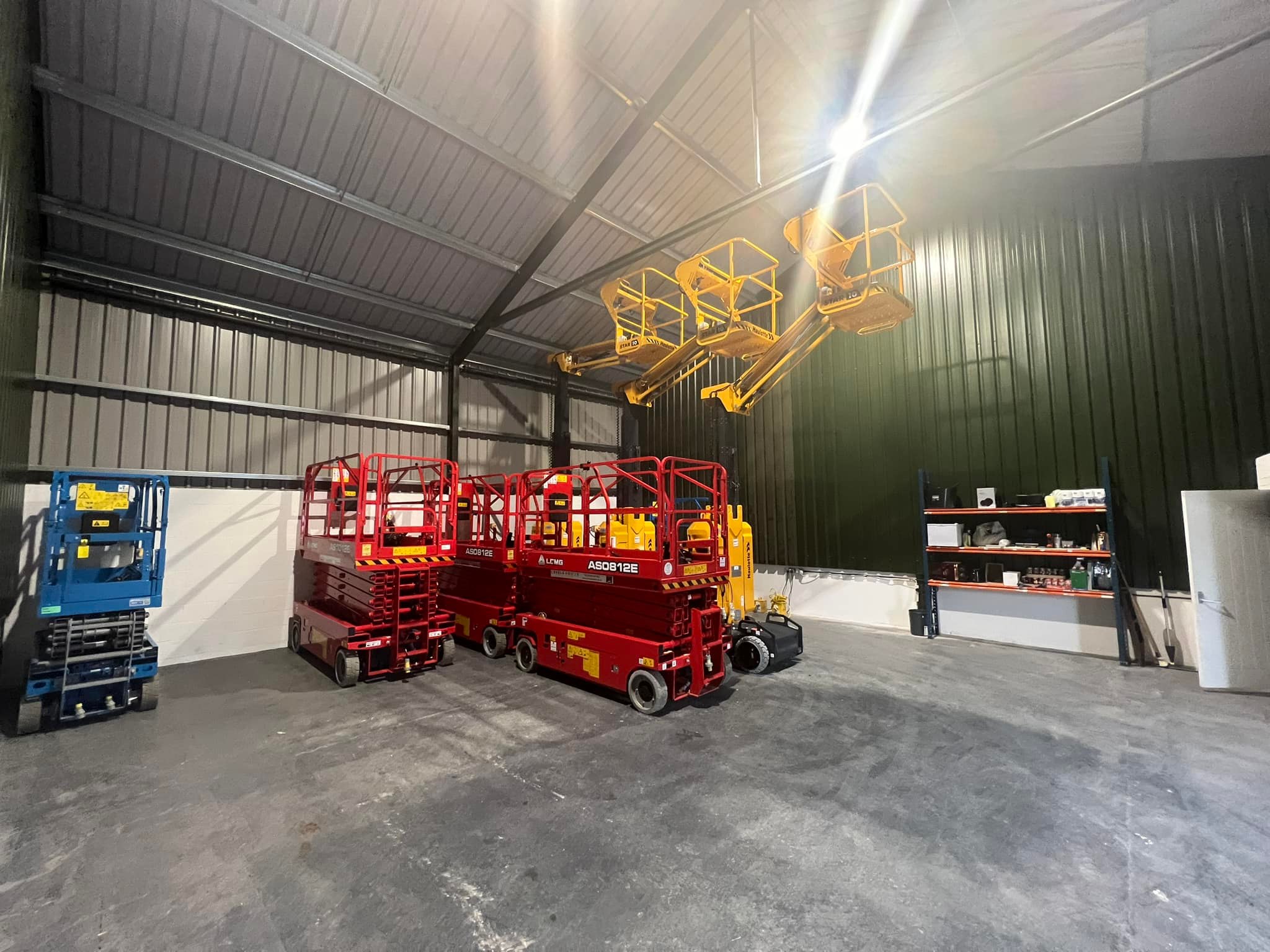

Some access platforms are narrow enough to pass through relatively small doorways, but width is only one part of fitting a machine into a building. Stowed height, length, turning space, thresholds and floor capacity can decide whether it reaches the job.
Smaller dimensions also do not produce one universal height limit. Low-level platforms, micro scissors, mast booms and compact tracked machines solve different problems. Comparing them by their narrowest measurement alone can give a misleading answer.
| Measurement | Standard indoor Pecolift example | Genie GS-1932m CE/UKCA example |
|---|---|---|
| Width | 700 mm | 810 mm |
| Stowed length | 985 mm | 1,400 mm |
| Stowed height | 1,550 mm | 1,970 mm with fixed rails |
| Maximum working height | 3.50 m | 7.55 m indoors; 6.57 m outdoors |
| Maximum platform height | 1.50 m | 5.55 m indoors; 4.57 m outdoors |
The standard indoor Pecolift example is a manually elevated low-level platform. It uses stored mechanical energy rather than the powered scissor mechanism of the Genie example. The Pecolift manual also covers other configurations, so the restrictions for one example must not be applied to every variant.
These figures demonstrate different approaches to compact access. They are not a recommendation that either model fits a particular doorway or is currently available for your dates. Refer to the supplied machine's own dimensions and manual.
A door's nominal size can differ from the clear opening once the leaf, hinges, closer or handle are taken into account. The route may then turn immediately into a corridor, pass under another obstruction or cross a raised threshold. A machine can fit through a straight opening and still have no room to make the next turn.
Measure the clear width and height at the narrowest points, then record the available space on either side. Include ramps, loading bays, floor changes and any goods lift. If guardrails can fold, check what the manufacturer permits and the resulting transport dimensions; do not assume that removing a component is an acceptable way to make it fit.
A compact machine still contains its structure, drive system and, where fitted, batteries. A narrow chassis can put substantial loads through a small number of contact points. Passing a doorway does not establish that the floor or a goods lift can carry it.
Tell the hire desk about raised floors, basements, service ducts, covers or loading restrictions. Where structural capacity is uncertain, obtain the appropriate assessment rather than estimating it from how heavy the machine looks.
Some machines travel in a compact configuration and need more space to work. A tracked or spider-type platform may fold narrowly for access but require a larger support arrangement once positioned. A mast boom may also need clearance for rotation or outreach.
This is why a small transit width does not translate into a fixed maximum working height. Ask two questions: will the machine reach the position, and can it then operate there within its approved limits?
Photographs with measurements marked on them are useful. Include the difficult parts of the route, not only the open space at the destination. Where the measurements leave little clearance, arrange a site survey before selecting equipment.
For modest overhead tasks, look at low-level access equipment. For additional vertical height, a compact scissor may be relevant. Where outreach matters, compare mast booms and other boom types. Tracked boom options bring another set of access and support dimensions to check.
The right starting category saves time, but it does not replace a model-specific assessment. Be clear about the route and the work, then compare the machines that meet both.
Send doorway measurements, photos of turns and thresholds, the task height and any loading restrictions. We can help identify the details that need checking.
Call 0330 058 0982 or email hire@levelsaboveltd.co.uk.
Sources checked in November 2026. For equipment specifications, use the documentation for the machine and configuration supplied.