


Providing access to the machines you need
Levels Above can cater to your machine requirements with ease, simply contact our Hire Desk to let us know what you need today:

Hire Desk
Unit D, Fox Way, Trinity Business Park, Wakefield, WF2 8EE
Levels Above can cater to your machine requirements with ease, simply contact our Hire Desk to let us know what you need today:
Unit D, Fox Way, Trinity Business Park, Wakefield, WF2 8EE
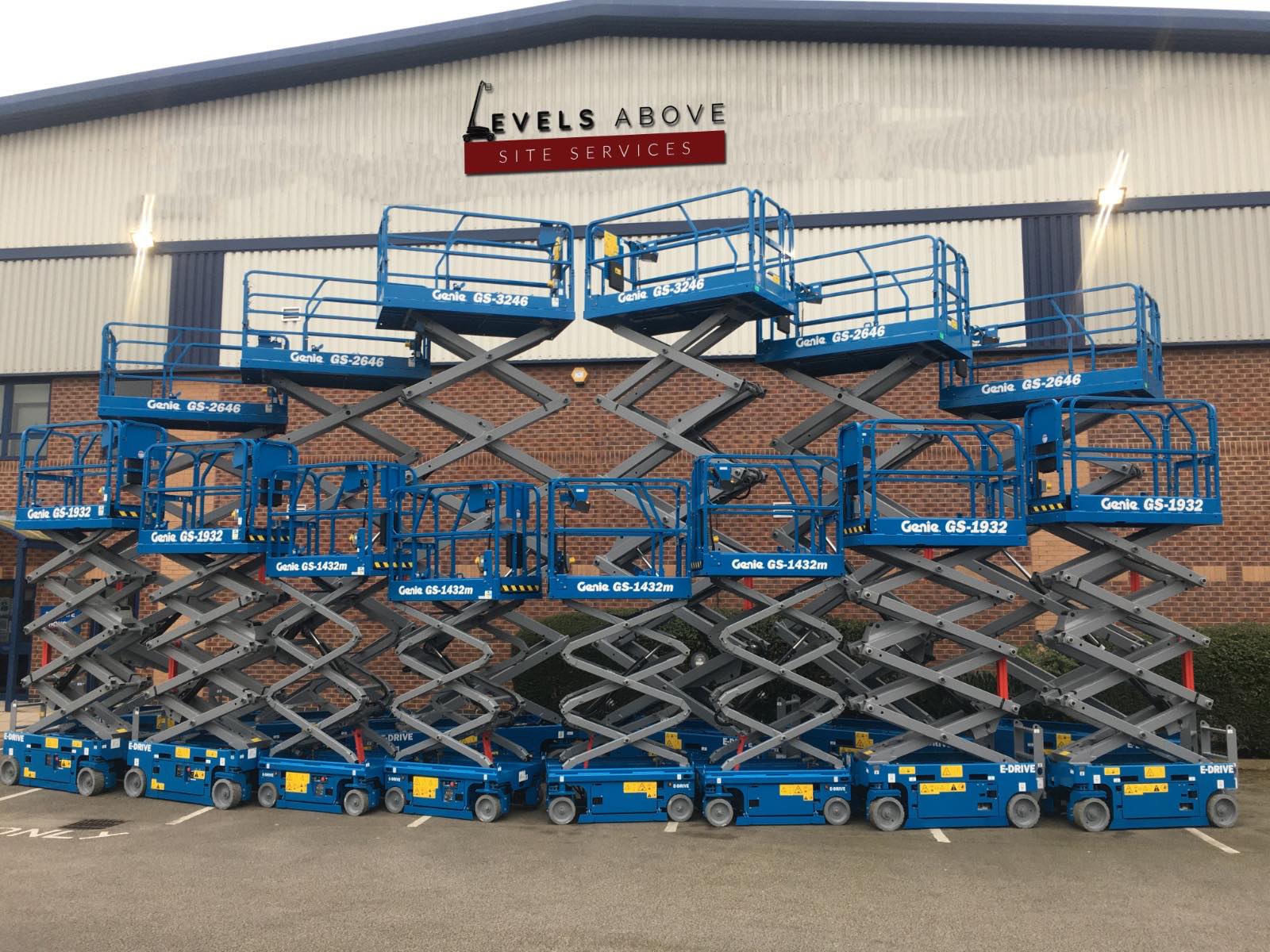

Scissor lifts cover a much wider height range than their compact appearance might suggest. A small indoor model can suit a maintenance task several metres up, while specialist machines can reach working heights of more than 30 metres. The useful answer is the height a suitable machine can achieve on your particular site.
That last point matters. The tallest machine in a brochure may be too wide for the route, too heavy for the floor or unnecessary for the job. Start by separating the different height measurements.
Platform height is the elevation of the platform floor. Working height is a manufacturer's stated reach convention. On the Genie specification used below, the metric working-height figure adds two metres to the platform height.
That allowance helps compare specifications; it should not encourage someone to stretch, stand on the guardrails or add steps inside the platform. The actual task needs a comfortable position within the machine's approved limits.
| Model and setting | Working height | Platform height |
|---|---|---|
| Genie GS-1932m, indoor CE/UKCA specification | 7.55 m | 5.55 m |
| Genie GS-1932m, outdoor CE/UKCA specification | 6.57 m | 4.57 m |
| Dingli JCPT3730HRT, specialist high-reach example | 37.00 m | 35.00 m |
These examples illustrate the range; they are not a current Levels Above stock list. Check the model, variant and documentation supplied with any hire. Notice that the same Genie model has different maximum heights indoors and outdoors.
Dingli's published JCPT3730HRT specification lists a 37-metre working height, 750 kg safe working load, three-metre overall width and an overall machine weight of approximately 39,800 kg. It is a specialist machine, with transport and ground-support requirements on a very different scale from a compact indoor scissor.
It is a useful example of what the category can include. It is not a claim that it is the tallest scissor ever built, nor that this particular machine is currently available from Levels Above. Any specialist requirement needs its own availability and suitability discussion.
Large industrial buildings can have services and working areas far above an ordinary office ceiling. High-bay lighting, ventilation, fire-protection systems and installation work can all lead to a high-level access requirement. Building shells, large production spaces and substantial maintenance projects can create similar questions.
A scissor platform may be worth considering where a clear position below the work is available and platform space is useful. If access must reach over an obstruction, a boom lift may be the more suitable starting point, even when its maximum height is similar.
These are possible applications, not accounts of particular customer jobs. The machine choice comes from the actual work area, load and operating conditions.
A building's overall height does not necessarily tell you the required platform height. Measure the task location, where the machine could stand and any obstacles between the two. Explain whether the work moves along the building or stays at one location.
It is also worth telling the hire desk about doors that only open part of the day, delivery restrictions and whether the building will remain occupied. A machine that reaches the task but cannot be delivered or repositioned at the required time is not a workable answer.
Our site survey guide explains the information a survey can establish. You can also view scissor lift hire options and ask about operator training.
Send the task height, site photographs, access measurements and any known floor or ground limits. We will discuss suitable options and availability.
Call 0330 058 0982 or email hire@levelsaboveltd.co.uk.
Sources checked in November 2026. For equipment specifications, use the documentation for the machine and configuration supplied.