


Providing access to the machines you need
Levels Above can cater to your machine requirements with ease, simply contact our Hire Desk to let us know what you need today:

Hire Desk
Unit D, Fox Way, Trinity Business Park, Wakefield, WF2 8EE
Levels Above can cater to your machine requirements with ease, simply contact our Hire Desk to let us know what you need today:
Unit D, Fox Way, Trinity Business Park, Wakefield, WF2 8EE
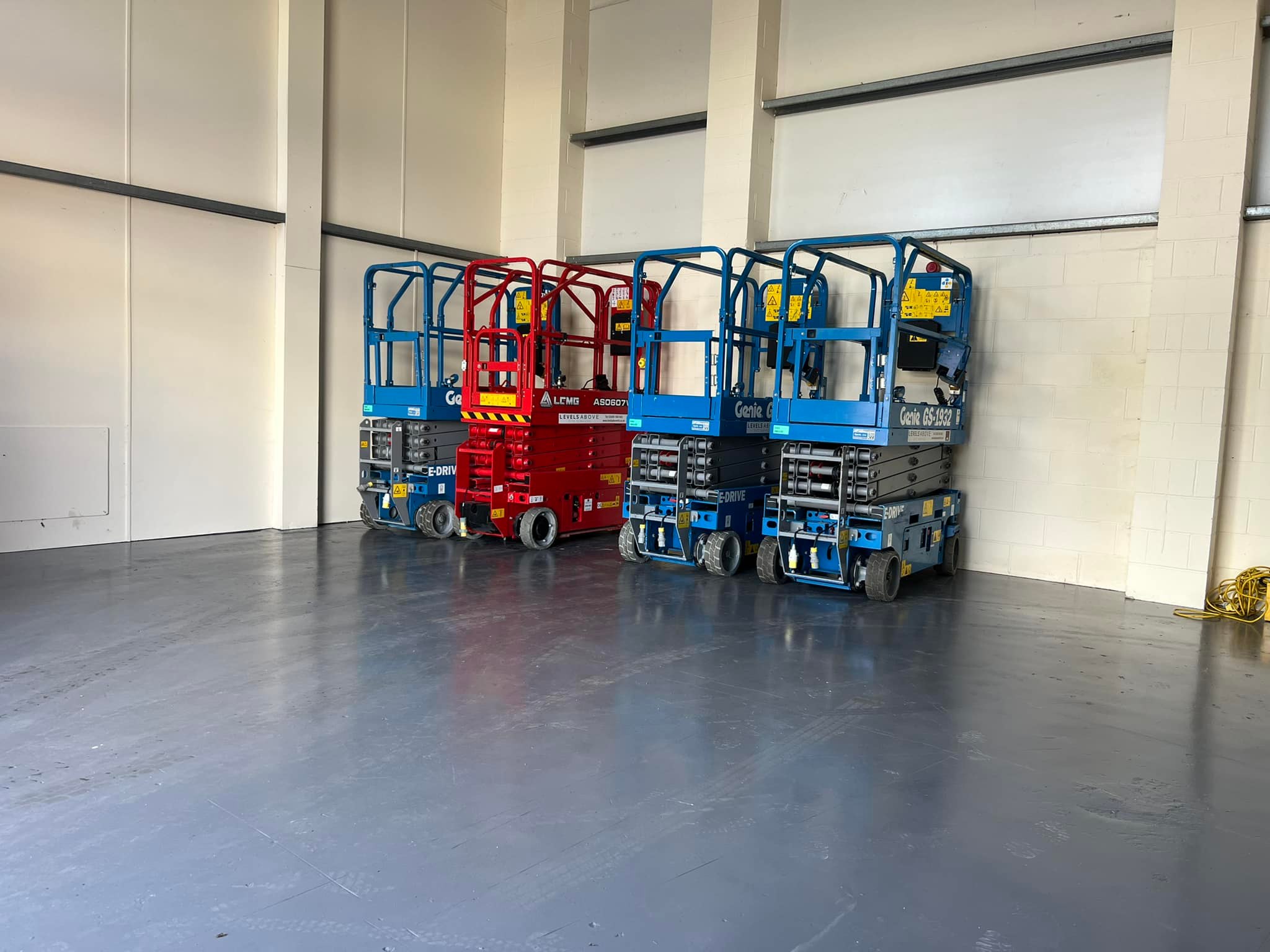

A scissor lift is usually the starting point when you need to work directly above the machine. A cherry picker, or boom lift, is usually the better starting point when you need to reach out, over or around something. The right choice depends on the route to the job and the space available as well as the height.
Both are types of mobile elevating work platform, often shortened to MEWP. Neither is a substitute for assessing the site and checking the particular machine's limits. Here is how to narrow down the choice before you call the hire desk.
A scissor lift raises its platform using linked, crossing supports. The chassis sits below the working area, which makes this type useful for jobs such as installing overhead services along a clear aisle or maintaining lighting in a suitable building.
A boom lift carries its basket on an arm. An articulated boom has joints that help it reach around obstructions; a telescopic boom extends a more direct arm. A cherry picker is a common name for this equipment, rather than a promise that every model has the same reach or chassis.
Some scissor lifts have extending decks, so it is too simplistic to say they have no horizontal extension. The important distinction is whether the required working position falls inside the machine's approved working envelope.
| Consideration | Scissor lift | Cherry picker / boom lift |
|---|---|---|
| Working position | Usually above the chassis, sometimes with an extension deck. | Can provide horizontal outreach and access over obstacles. |
| Platform space | Often useful when deck space for a team or materials matters. | Basket space and capacity depend on the model and configuration. |
| Typical task | Overhead installation or maintenance with a clear route below. | Reaching a facade, roof edge or position beyond an obstruction. |
| Access and ground | Check width, length, floor loads and operating conditions. | Also check turning space, tailswing and the full reach chart. |
| Power | Electric and engine-powered models serve different settings. | Electric, hybrid and engine-powered versions have different requirements. |
A task may be 10 metres above the ground but six metres beyond the nearest place where a machine can stand. That is a different requirement from a task at the same height directly overhead. Equally, a high maximum outreach figure does not mean that reach is available at every height or with every permitted load.
Describe the working position in relation to the proposed machine position. Include the height and depth of anything between them, such as a canopy, pipe run or building extension. The reach chart for a named model is more useful than choosing the largest number on a specification sheet.
Check whether a quoted height means platform height or working height. Manufacturers commonly express metric working height as platform height plus an allowance for a person's reach; that convention is not a guarantee of what every operator can reach safely.
A clear warehouse aisle: the conversation may start with an electric scissor lift. The access width, floor capacity, task height, number of people and materials still need checking. A compact machine is not automatically light enough for every floor.
Maintenance beyond a canopy: an articulated boom may provide a suitable route to the work. The canopy's height and depth matter, as do the available standing position and the loads in the basket.
Outdoor installation: engine power and rough-terrain features may be relevant, but they do not make unassessed ground suitable. Access, ground bearing, weather and the model's operating limits remain part of the choice.
Photos and a simple sketch often make this easier. If the route or working position is uncertain, a site survey can help establish what needs measuring before equipment is selected.
HSE guidance calls for appropriate operator training and familiarisation with the specific make and model. Plan how the equipment will be managed and how a person could be recovered in an emergency. Follow the supplied manual rather than a general rule about all scissors or all booms.
Browse our scissor lift hire and cherry picker hire options, or read our broader introduction to powered access.
Tell us where the work is, what is in the way and how the machine will get there. We can discuss suitable equipment and current availability.
Call 0330 058 0982 or email hire@levelsaboveltd.co.uk.
Sources checked in November 2026. For equipment specifications, use the documentation for the machine and configuration supplied.